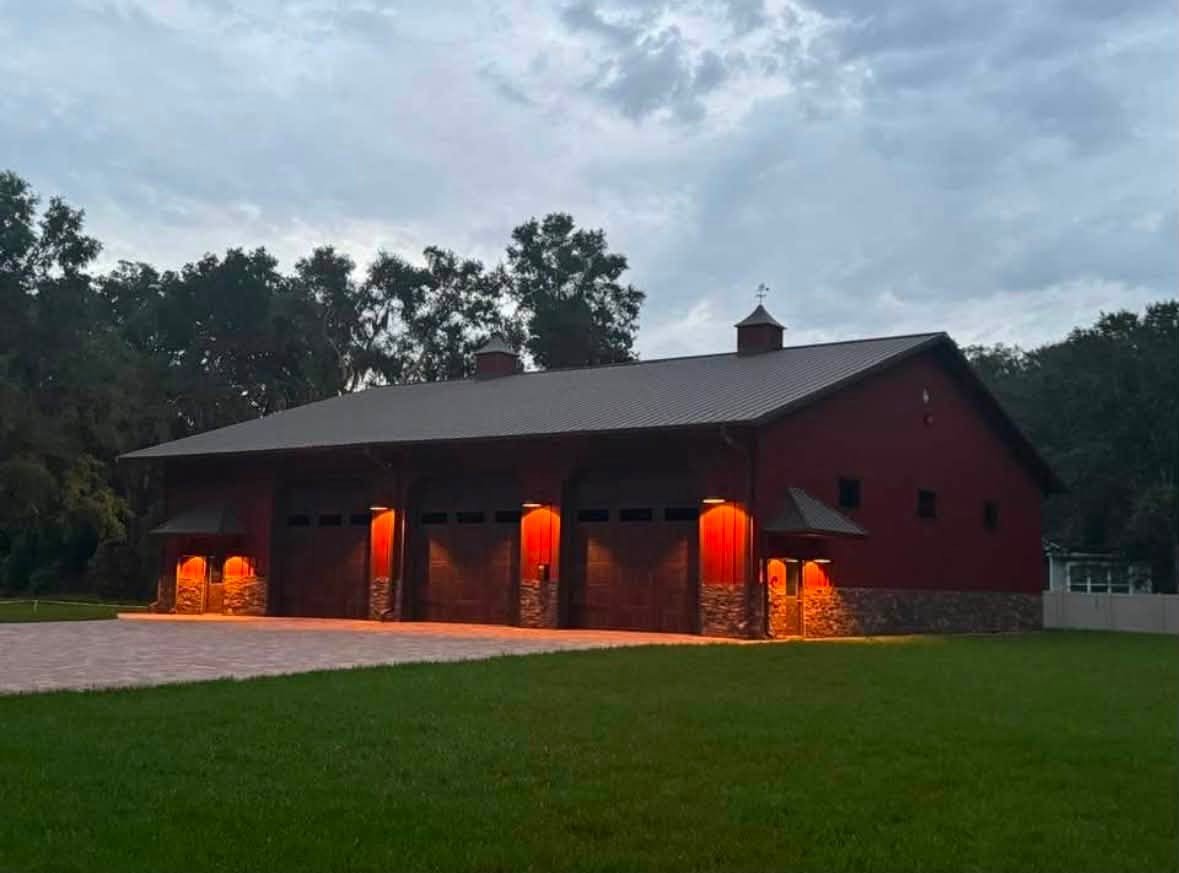
It's one of the first questions we hear from people building a barn: "How big of a service do I need?" The honest answer is that it depends on what the barn will do. A four-stall barn with lights and a few fans is a very different load than a 20-stall show barn with a wash rack, a laundry room and an apartment upstairs.
Here's what drives the number, so you can have a better conversation with your builder and electrician.
The big loads in a barn
Fans
In Florida, fans are often the biggest everyday load. A fan in every stall, plus aisle fans, running all day from April through October adds up. Plan dedicated circuits so a tripped breaker doesn't shut down a whole row.
Lighting
Modern LED fixtures use far less power than old metal-halide or fluorescent lights, which helps a lot. Covered arenas still need a good number of fixtures for even light, but LED keeps that load manageable.
Wash racks and water
Electric water heaters for wash racks, the well pump, and any heated waterers can be significant. Wash racks also need GFCI protection because of the water.
Living quarters, laundry and tack rooms
An apartment over the barn adds everything a small house has: HVAC, a range, a water heater, a fridge. Barn laundry (washers and dryers for saddle pads and blankets) and air-conditioned tack or feed rooms add more.
Shop equipment and the future
Welders, compressors, a golf cart or EV charger, an RV hookup for show season: think about what you might add in five years, not just day one.
Tip: make a simple list of every stall, fan, light, appliance and piece of equipment you plan to have, and bring it to your electrician. That list is how the service gets sized correctly.
Separate service or a subpanel?
Many barns are fed from a subpanel off the house service. That can work for smaller barns that are close to the house. Larger barns, barns far from the house, or barns with living quarters often do better with their own meter and service from the utility. A separate service can also make backup power simpler, since you can put the barn and well on their own generator.
The right choice depends on the loads, the distance, and what your power company will provide. An electrician can work through it with you and coordinate with the utility.
Barn wiring is not house wiring
Dust, hay, moisture, rodents and animals make barns tough on electrical equipment. Good barn wiring usually includes:
- Fixtures and boxes rated for damp or wet locations
- Wiring run in conduit or otherwise protected where animals or equipment could reach it
- GFCI protection at wash racks and other wet areas
- Lights and outlets placed where horses can't chew or rub on them
- Clear labeling so anyone on the farm can find the right breaker
Plan before the slab
The cheapest time to get barn electrical right is before the concrete is poured and the walls go up. Underground conduit, outlet locations at every stall, and the path for a future generator are all easy to add on paper and expensive to add later. Bring your electrician in when you're working out the barn plans.
Building a barn?
Send us your plans and we'll help size the service.